
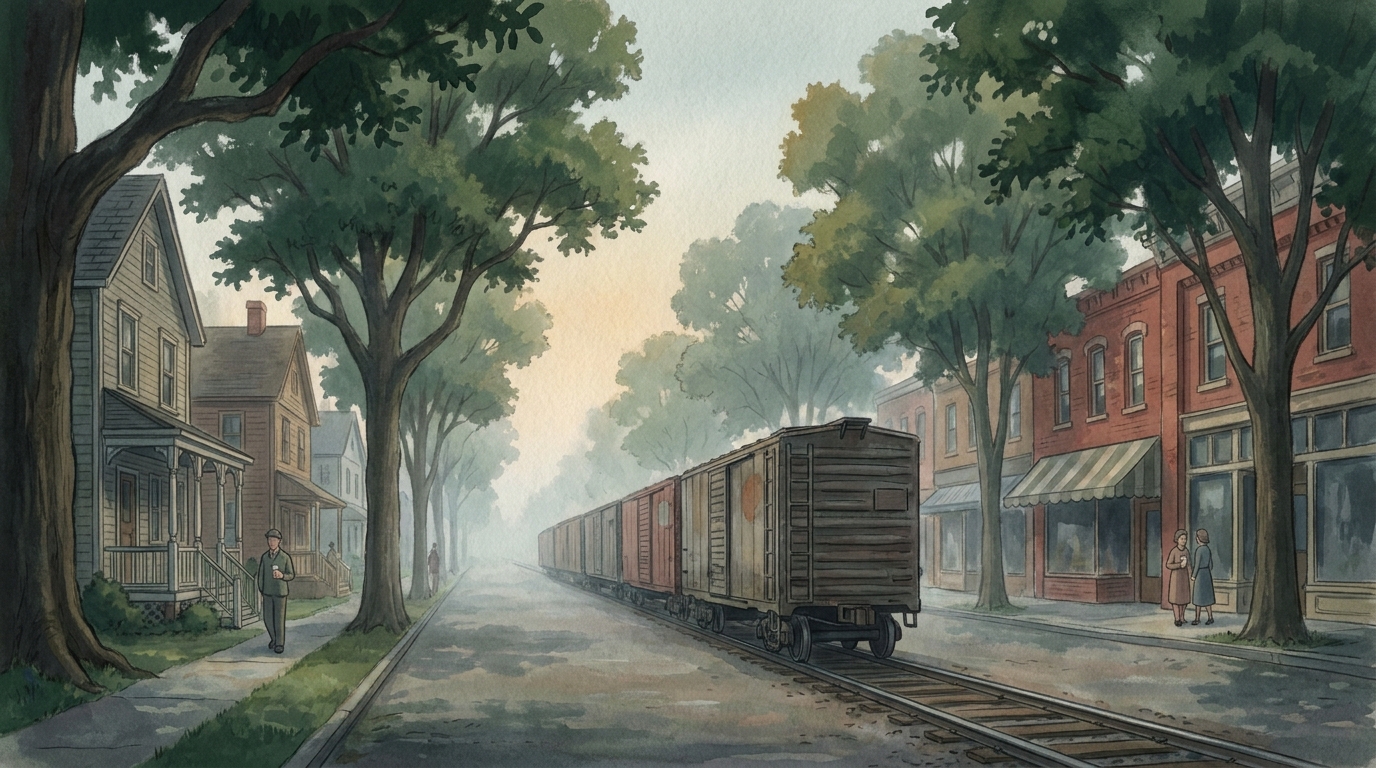
It is a little after eight on a Saturday in Ashland, Virginia. A crossing bell starts to ring, the coffee crowd on the sidewalk looks up, and a long CSX freight rolls slowly down the middle of the street, between Victorian porches and brick storefronts. Two minutes later all is quiet again. Nobody seems surprised. In a community of 7,565 people, passing locomotives are part of the scenery.
Ashland sits 16 miles north of Richmond on U.S. Route 1, just off Interstate 95, and it is the only incorporated municipality in Hanover County. Locals like to call it “the Center of the Universe,” a phrase the local government uses in its own branding. The story behind the place explains a lot of what you see on that Saturday morning.
How a rail company built a resort
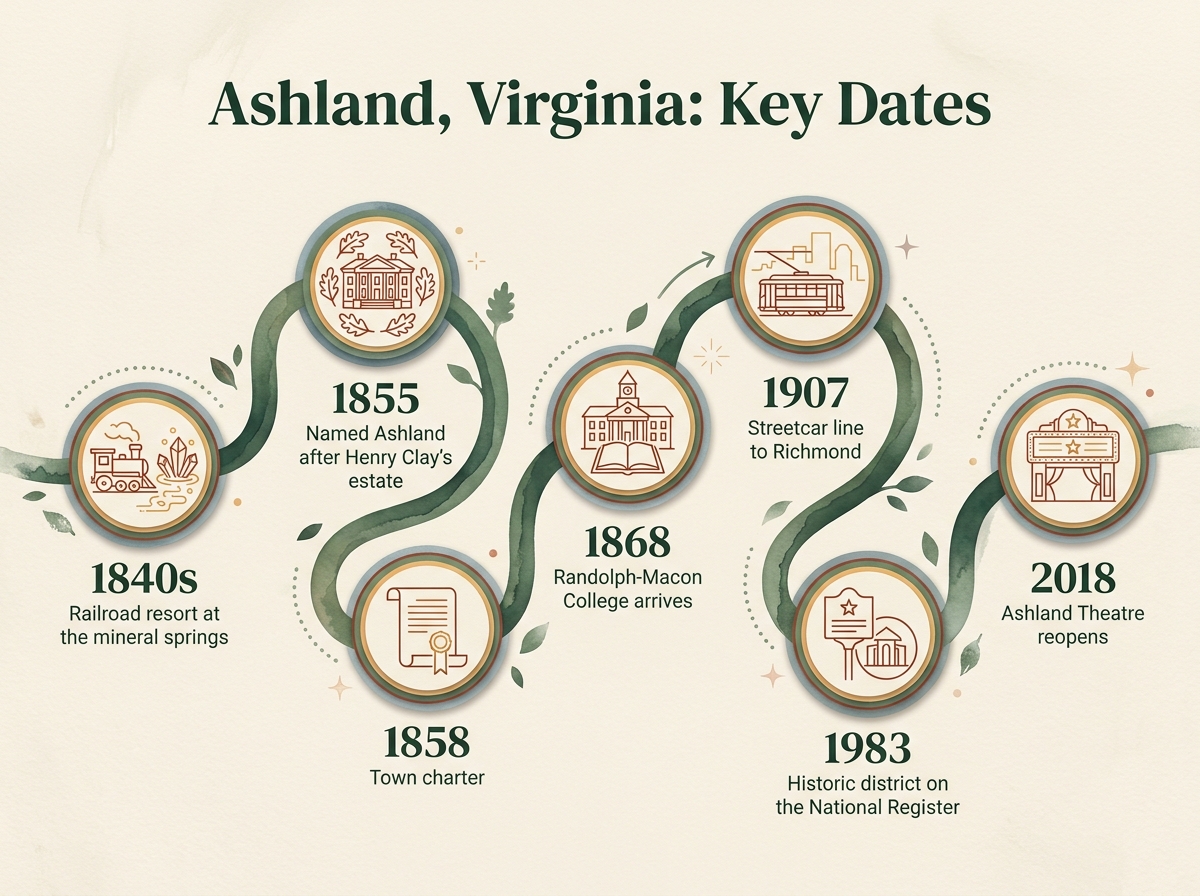
Ashland exists because of the Richmond, Fredericksburg and Potomac Railroad. In the 1830s and 1840s the company developed the land around a set of mineral springs into a resort, complete with a hotel building and a racetrack, to give city dwellers a reason to buy a ticket north. The original settlement was known as Slash Cottage, after the low, swampy “slashes” of the surrounding countryside.
In 1855 the community became Ashland, named after the Kentucky estate of Henry Clay. The statesman had been born nearby in 1777 and served as Speaker of the House and Secretary of State of the United States. The General Assembly granted a charter on February 19, 1858.
Several later events shaped what you can visit today:
- In 1868 Randolph-Macon College moved here, leaving its first campus in Boydton, in southern Virginia. Its brick quadrangle still borders the old core.
- In 1907 an electric streetcar line opened to Richmond. It ran until 1938 and made the place one of the region’s first commuter suburbs. A former car barn is one of the last remains.
- After World War II, Route 1 and then Interstate 95 brought motels, gas stations, restaurants and new neighborhoods to the edges, a building boom that lasted until the mid-1960s.
Why the trains run through the middle of Main Street
The rails were laid before most of the houses went up, so the community grew around them. The line runs straight through the core, flanked by Center Street and Railroad Avenue. When the district took shape at the turn of the 20th century, a house facing the depot was a sign of status. According to the Virginia Department of Historic Resources, the tracks and the parallel Center Street form the spine of the Ashland Historic District, lined with Italianate, Queen Anne and Colonial Revival houses. The district was added to the National Register of Historic Places in 1983.
Today the corridor carries CSX freight and Amtrak’s Northeast Regional, which stops at the depot in the middle of the district. You can ride to Richmond, Washington or New York without ever getting in a car. Plans to widen the corridor for more passenger service have been debated for years, because a third track would change the character of the neighborhood.
What to see in Ashland
The historic core is small enough to walk in an hour, but most visitors take more time. These are the places worth a stop:
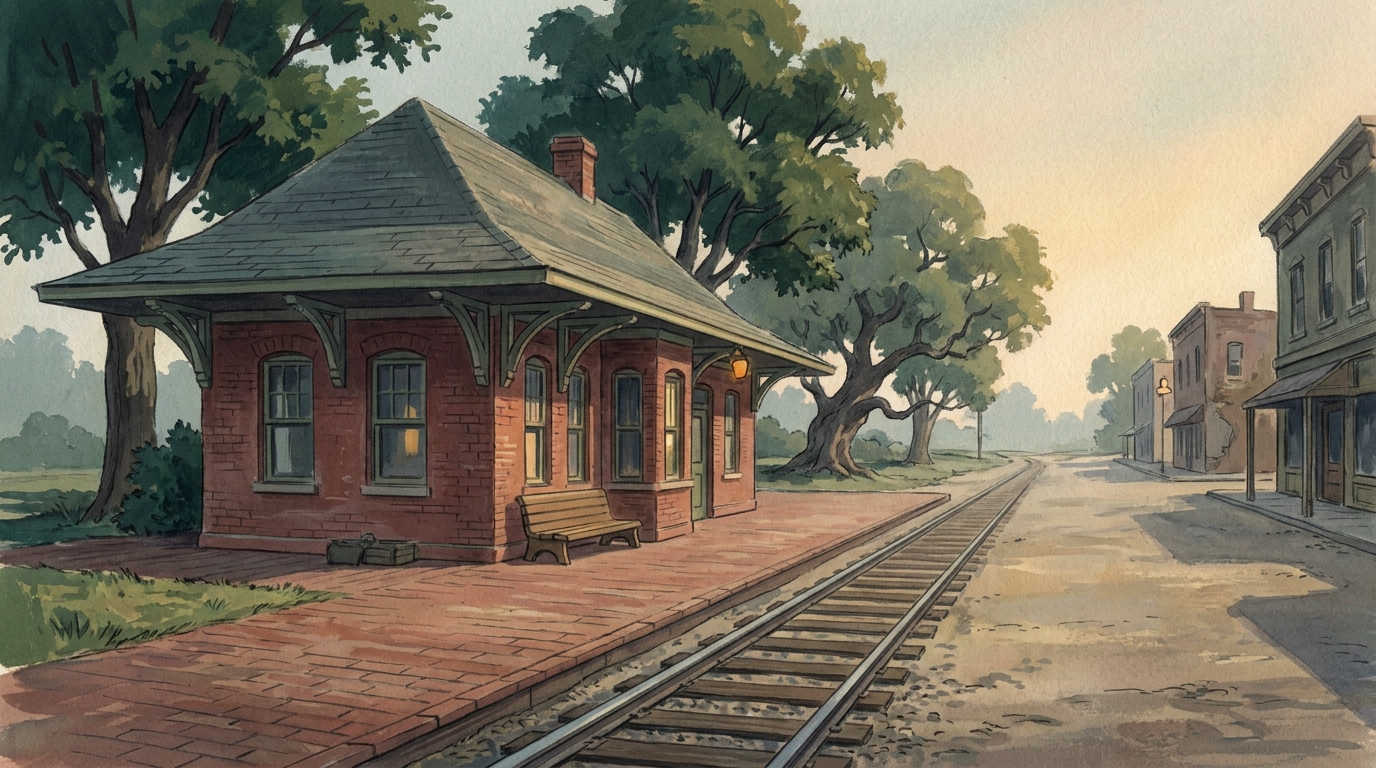
- The visitor center in the 1923 depot, which hands out maps and tips for the whole county
- The local museum, which tells the story of the rail line and keeps a restored red caboose built in 1926
- The Ashland Theatre, an art deco cinema opened in 1948 that reopened in 2018 after a full renovation and shows new releases, classics and live events
- Randolph-Macon College, whose Keeble Observatory hosts public stargazing nights
- The Henry Clay Inn, home of the Hanover County Black Heritage Society, which documents the history of the community’s Black residents
- Carter Park, 13.5 acres of walking trails, picnic areas and a pool
Downtown Ashland has independent shops, a few antique stores, cafés and restaurants on Railroad Avenue and England Street. Many sit within sight of the rails, so you can watch the freight cars roll past over lunch. Small family businesses still outnumber the chains in the old commercial blocks, most of them brick buildings from the 1920s.
The year in Ashland
The calendar follows the seasons. These are the events most residents mark:
| Month | Event |
|---|---|
| Spring | Ashland Train Day: rail displays and family activities |
| Early June | Ashland Strawberry Faire: crafts, music and food |
| July | Hanover Tomato Festival in nearby Mechanicsville |
| Fall | pumpkin and apple season at Ashland Berry Farm |
| December | Ashland Christmas Parade along Route 54 and Railroad Avenue |
Dates shift every year, so check with the organizers before you plan a trip around one of them.
Living in Ashland
People move here for small-community life within commuting distance of Richmond. The historic district has old houses on large lots, and newer neighborhoods have grown on the edges. Randolph-Macon College brings students, lectures and sports, and an Amtrak stop is rare for a place this size.
There are drawbacks. Freight passes through day and night, and the horns can be heard across much of the area. Traffic on Route 1 and Route 54 builds at rush hour, and most errands still mean driving.
Getting there
- By car: about 20 minutes north of downtown via I-95, exit 92
- By rail: Amtrak Northeast Regional stops at the historic depot
- By air: Richmond International is about 30 minutes away
The town also makes a good base for exploring the county. Kings Dominion is ten minutes north, and the farm stands that sell Hanover tomatoes in summer are a short drive east.
Questions and answers
Why is Ashland called the Center of the Universe?
It is a local nickname that the town also uses in its own branding. Residents use it with a wink for a small town where the railroad, Route 1 and Interstate 95 all meet.
Does Amtrak stop in Ashland, Virginia?
Yes. Amtrak Northeast Regional trains stop at the station in the middle of the historic district, with connections to Richmond, Washington and New York.
What college is in Ashland, Virginia?
Randolph-Macon College, which moved to Ashland in 1868. Its campus borders the historic town center.
Sources
- Virginia Department of Historic Resources: Ashland Historic District
- Ashland Museum: Railroad History
Last reviewed: