

For more than a century, the Herald-Progress was how residents of Ashland and Hanover County learned what had happened that week. It covered school board meetings and high school football, church suppers and county elections, local government, obituaries and new businesses on Route 1. When the weekly newspaper printed its final edition in March 2018, the community lost its oldest local news service.
This page tells the story of the paper, explains why it closed and shows where its pages and photographs can be found today. It is written for former readers, for families researching their history and for anyone curious about the name on this website.
A note on this website
The website you are reading is not the newspaper. Herald-Progress today is an independent guide to Hanover County and Ashland that took over the web address after the paper closed. None of the paper’s former editors or reporters write for it, and it has no business connection with the companies that owned the newspaper. We keep the name because the paper deserves to be remembered, and this page is part of that.
From two papers to one
The roots of the Herald-Progress reach back to 1881, which is why the closing coverage in 2018 spoke of 137 years of publishing. For its first decades there were competing weeklies, each with its own editor and its own stories. In 1919 the Hanover Herald and the Ashland Progress merged, and the hyphenated name was born. The inaugural issue of the combined paper acknowledged how hard it was to bring two staffs together into one.
The Watkins years
In 1933 Paul and Lois Watkins moved to Ashland from Chicago and took over the paper. They were newcomers to Virginia. Their arrival began a family era of nearly five decades, during which the Herald-Progress reached its largest circulation. After Paul Watkins died in 1951, Lois became publisher and editor. Their daughter, Marion Watkins Herget, came back to Ashland in 1954 to help her mother and became editor in 1963.
Under the Watkins family the paper grew into the public record of community life. Each week readers turned to it for:
- school news and honor rolls
- weddings, births and obituaries
- Board of Supervisors and Town Council meetings
- Friday night football at the county’s high schools
- letters to the editor that often ran for pages
Jay Pace and the paper’s later decades
Malcolm “Jay” Pace III joined the staff in 1973, became editor of the Herald-Progress in 1978 and in 1981 bought the paper and its printing company, which he then ran as his own business. He led it for more than two decades, and his editorial voice made him one of the best-known figures in town. Pace died suddenly in 2004, and a statue of him now stands near the Ashland branch of the Pamunkey Regional Library.
In the years that followed, the paper passed to owners outside the county. In 2008 Lakeway Publishers of Morristown, Tennessee, bought it, and the Herald-Progress became one of the company’s Virginia weeklies, alongside the Caroline Progress in Bowling Green, Caroline County, Virginia, which had served its own community for nearly a century.
The final years
Greg Glassner, who lives in Caroline County and has more than forty years in newspapers behind him, served as editor of the Herald-Progress for eight years until he retired in 2012, and he still wrote for both papers until they closed. In his account for the Columbia Journalism Review, the paper at the end was produced by an editor, one full-time reporter, one part-time reporter and a few freelancers. For the most part, that small staff still filled the pages each week with the news, stories and photos that readers expected.
Money had been a problem for years, and other weeklies in Virginia were struggling as well. According to Glassner, free weeklies from the Richmond Times-Dispatch and the Mechanicsville Local took over the legal notices that county and town government had once placed in the paper, and that loss of public advertising hastened its end.
Why the Herald-Progress closed
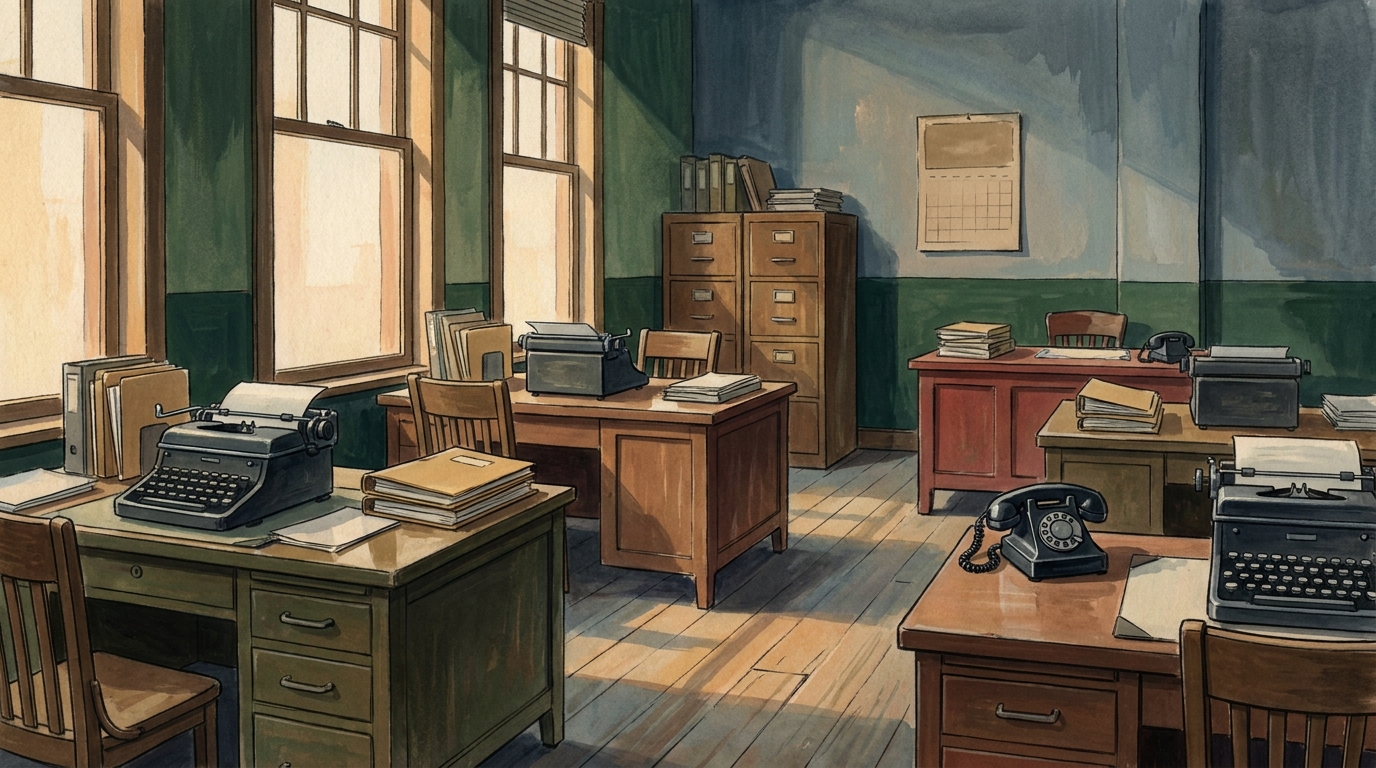
In March 2018 Lakeway announced that the Herald-Progress and the Caroline Progress would stop publishing. The company said the papers were no longer commercially viable. Staff members learned of the decision only days before the last issue, and the final edition of the Herald-Progress was distributed on Thursday, March 29, 2018. Accounts of its age differ: the closing coverage spoke of 137 years, while Glassner counted 131 years of service.
The closing followed a pattern seen across the United States. Advertising that once paid for small newspapers had moved online, and many local papers in rural and suburban counties shut down or merged in the same decade. The Library of Virginia wrote about the closures in Ashland, Bowling Green and Hopewell in April 2018 and noted that the three papers together had nearly three hundred years of publishing history.
Local leaders worried about what would fill the gap. Ashland’s mayor said at the time that it remained to be seen whether someone else would pick up the pieces.
What filled the gap
Two years later the Columbia Journalism Review and the Delacorte Review returned to the area for “Year of Fear,” a 2020 series that followed four towns week by week until Election Day. Its chapter on Caroline County asked what had replaced the Caroline Progress and the Herald-Progress. For the residents of Caroline County, the answer was a patchwork: local Facebook groups, where residents traded rumors and news about the pandemic, regional television, and free weeklies with few reporters of their own. Questions that would have been asked by a local editor at public meetings often went unasked, and residents could no longer count on one paper to tell them what their government had decided.
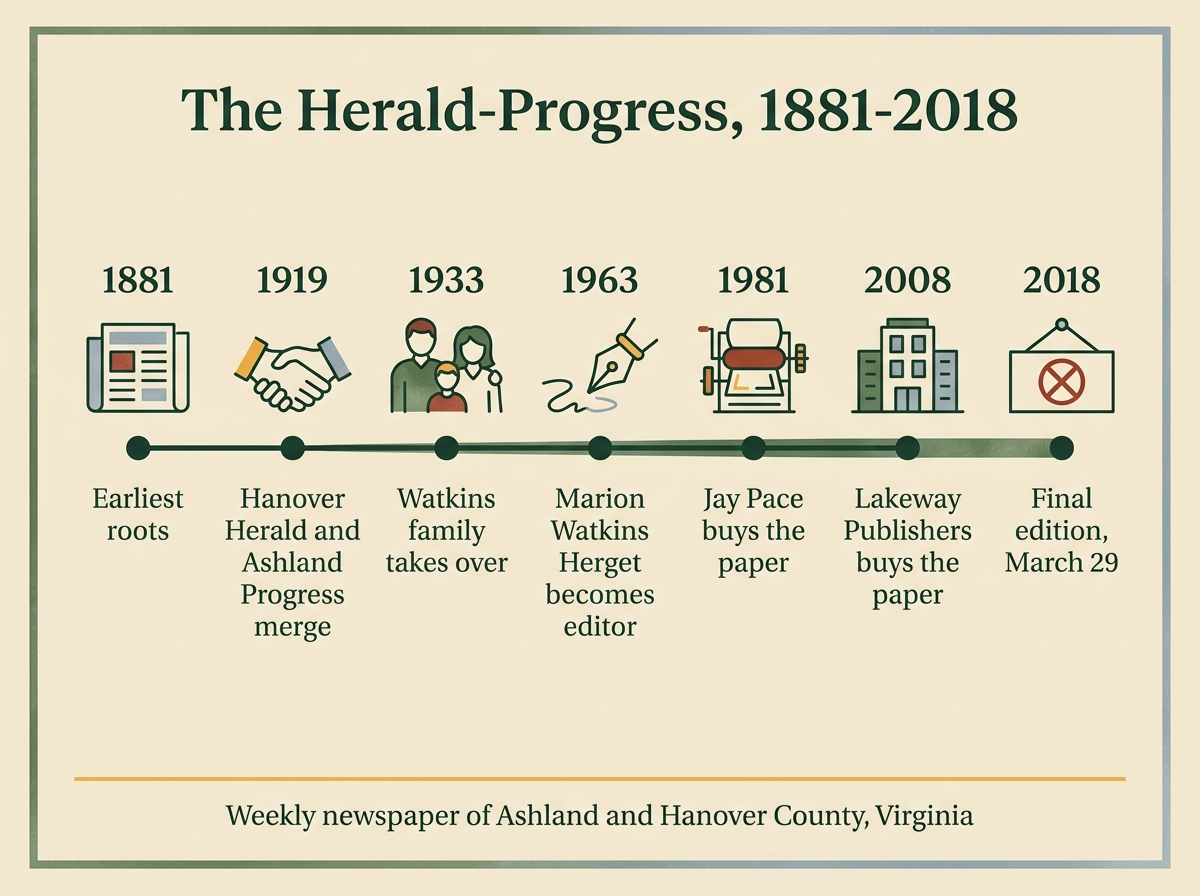
Herald-Progress timeline
| Year | Event |
|---|---|
| 1881 | earliest roots of the paper |
| 1919 | Hanover Herald and Ashland Progress merge into the Herald-Progress |
| 1933 | Paul and Lois Watkins take over |
| 1963 | Marion Watkins Herget becomes editor |
| 1981 | Jay Pace buys the paper and printing company |
| 2008 | Lakeway Publishers of Tennessee buys the paper |
| 2018 | final edition on March 29 |
Where to find old issues, obituaries and photos
Researching a family member, an old football season or the history of a house? These are the best places to start, and other local libraries and historical societies can help as well. It helps to know the approximate year before you get in touch.
- Randolph-Macon College in Ashland holds the Herald-Progress Collection in the Flavia Reed Owen Special Collections and Archives at McGraw-Page Library. The collection has more than 40,000 items, most of them photographs of Hanover County and Ashland from the 1960s to 2009, along with documents, articles and commemorative editions. Contact the archive by email at archives@rmc.edu before you visit.
- The Library of Virginia in Richmond keeps Virginia newspapers on microfilm, including early issues of the Herald-Progress. Ask the reference staff which years are available.
- The Ashland Museum collects local history and has profiles of the people who shaped the town, including the Watkins family and Jay Pace.
Tips for genealogy searches:
- Obituaries usually ran in the issue after the death, so search one or two weeks after the date you know.
- Note the exact week. The paper came out once a week, so issue dates matter more than daily dates.
- Ask archive staff for the commemorative editions, which often summarize decades of local history in one issue.
- Church records and funeral home files can fill gaps for the years after 2018, when there was no paper of record.
What the paper left behind
The Herald-Progress recorded more than a century of life through the eyes of the community in Ashland and the rest of Hanover County. Its photographs show the railroad town before Interstate 95, the growth of Mechanicsville and generations of graduating classes. For many families, a clipping from the paper is the only printed record of a wedding, an award or a life. They kept those pages for years, and many still have them.
If you have Herald-Progress clippings, photos or memories you would like to share, the archive at Randolph-Macon College is the right home for originals. We are happy to hear stories for this guide at info@herald-progress.com.
Questions and answers
When did the Herald-Progress close?
The final edition of the Herald-Progress was distributed on Thursday, March 29, 2018. Its sister paper, the Caroline Progress, closed at the same time.
Is this website the old Herald-Progress newspaper?
No. herald-progress.com is now an independent guide to Hanover County and Ashland. It is not connected to the paper's former owners or staff.
Where are the Herald-Progress photographs kept?
Randolph-Macon College in Ashland holds the Herald-Progress Collection, more than 40,000 items, mostly photographs from the 1960s to 2009.
Sources
- Library of Virginia: Ashland, Bowling Green & Hopewell, a Virginia newspaper vanishing act (2018)
- Randolph-Macon College: Herald-Progress Collection
- Ashland Museum: Paul and Lois Watkins
- Ashland Museum: Jay Pace
- Columbia Journalism Review: Year of Fear, Caroline County chapter
Last reviewed: