
The Battle of Cold Harbor was fought from May 31 to June 12, 1864, in Hanover County, Virginia, about ten miles northeast of Richmond. It was the last major battle of Ulysses S. Grant’s Overland Campaign and ended in a Confederate victory. A single Union assault on the morning of June 3 failed within about an hour, and it became one of the most costly attacks of the American Civil War, with heavy casualties for very little ground.
This guide follows the battle step by step, from the crossroads that gave it its name to the trenches that would shape the last year of the war.
Background: how the armies got to Cold Harbor
In May 1864 Grant, by then commander of all Union armies, traveled with the Army of the Potomac under Major General George G. Meade. Their opponent was General Robert E. Lee and the Army of Northern Virginia. Over four weeks of the Overland Campaign, Grant and Lee fought at the Wilderness, Spotsylvania Court House and the North Anna River. Each time Grant moved his army around Lee’s right flank and closer to Richmond, the capital of the Confederacy.
By the end of May both armies were in Hanover County. After fighting along Totopotomoy Creek near today’s Mechanicsville, Grant shifted south toward a dusty crossroads called Old Cold Harbor. The name had nothing to do with water. It probably came from an old tavern that offered shelter but no hot meals. Whoever held the crossroads controlled roads leading toward Richmond and the Chickahominy River, which made it a natural target for both forces.
The same ground had seen battle before. Two years earlier, during the Seven Days Battles of 1862, the Battle of Gaines’ Mill was fought over part of these fields.
Step 1: May 31, the cavalry takes the crossroads
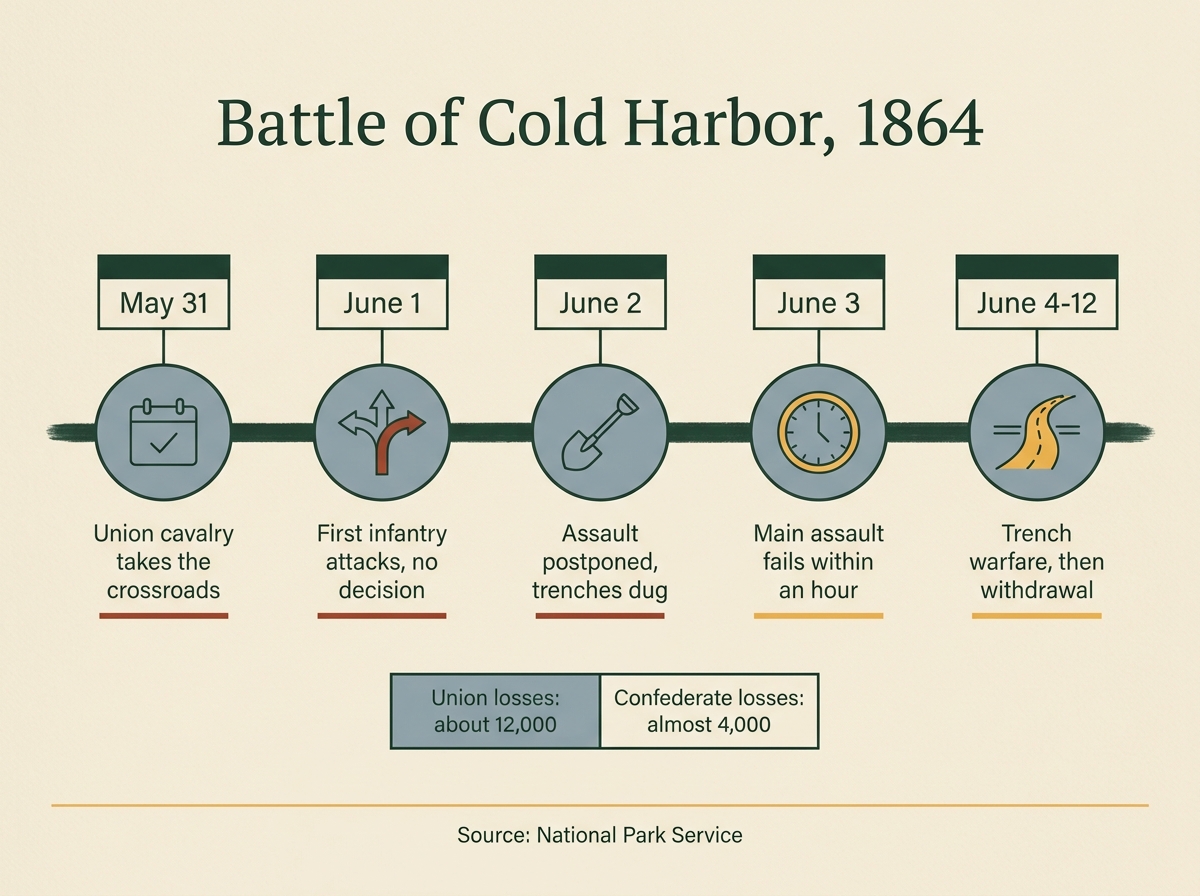
Union cavalry under Major General Philip Sheridan reached Old Cold Harbor first. After a short fight, they drove off the Confederate cavalry and held the crossroads. Lee ordered infantry to retake it, and Sheridan’s men dug in and waited for help.
Step 2: June 1, the first infantry attacks
In the morning, Confederate infantry from Major General Joseph Kershaw’s division attacked the cavalry and were turned back by rapid fire from the dismounted troopers. That afternoon two Union corps arrived: the VI Corps and the XVIII Corps, the latter brought from the Army of the James under Major General William F. Smith. Meade ordered them forward against the Confederate lines in the early evening, and the Union troops broke through at one point. A Confederate counterattack closed the gap. Both sides had lost heavily, and neither had won the field.
Step 3: June 2, a delay that changed everything
Grant planned a general assault for the next day, but the II Corps arrived late and exhausted after a night march, so the attack was postponed by another day. Lee used the extra time well. His men built a line of trenches and earthworks several miles long, with fields of fire that covered the open ground in front of them.
Step 4: June 3, the main assault
At dawn on June 3, three Union corps attacked along the line. The Confederate defenders were well protected and fired from their earthworks into the advancing Union soldiers. Most attacks stopped within about an hour, many of them only yards from the Confederate lines. Union forces that pressed on would find no way through. Some units managed to reach the trenches but were driven back.
What made the attack so deadly:
- The Union advance crossed open ground with little cover.
- The Confederate lines had been strengthened during the night and the previous day.
- The attacking corps were not coordinated, so defenders could concentrate their fire.
- Reconnaissance of the Confederate positions had been limited, and commanders did not know how strong the works had become.
Years later Grant wrote in his memoirs that he had always regretted that the last assault at Cold Harbor was ever made.
Step 5: June 4 to 12, trench warfare
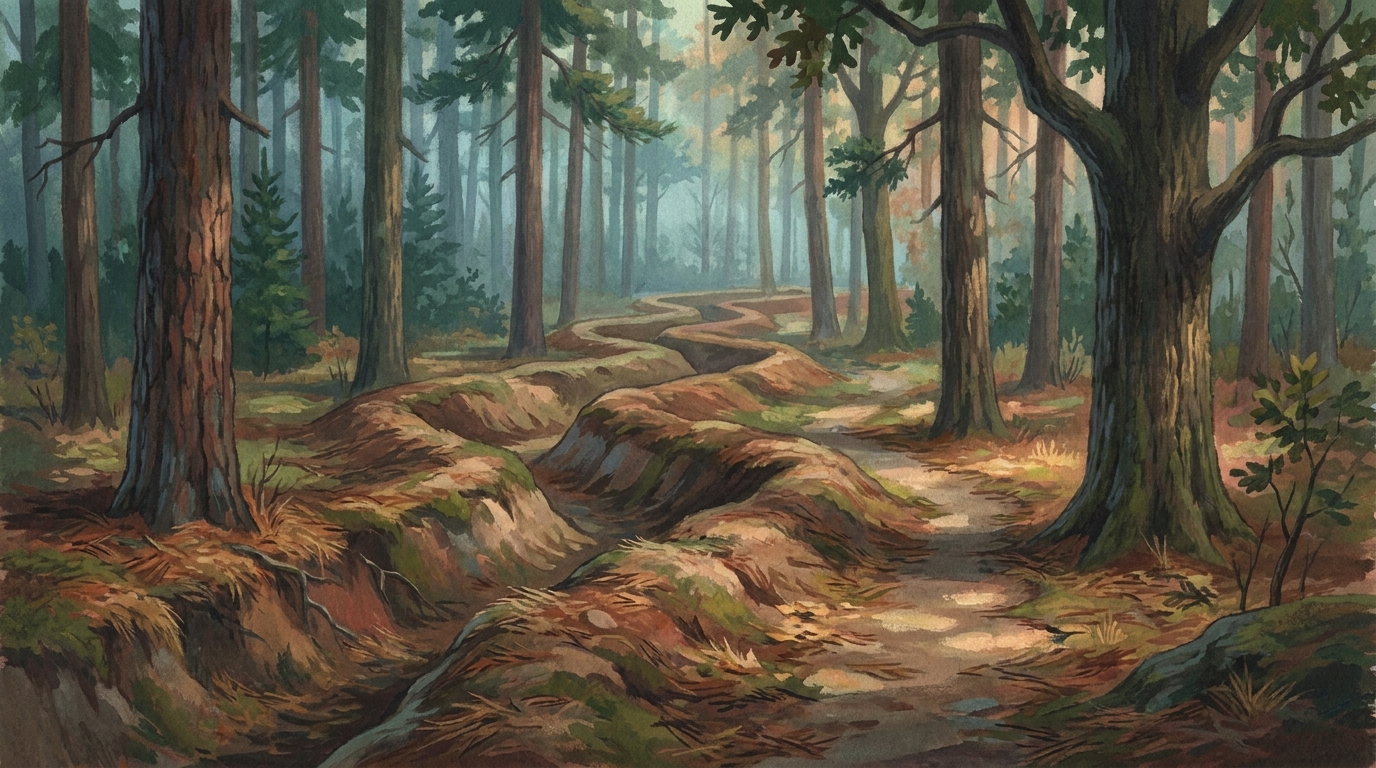
After the failed assault the two armies faced each other from their trenches, in some places only a short distance apart. Sharpshooters and artillery made movement in daylight dangerous. Wounded soldiers lay between the lines for days while Grant and Lee exchanged letters about the terms, until a short truce on June 7 allowed both sides to recover them. By then many of the wounded had died.
On the night of June 12 the Union army quietly left its lines, a withdrawal Lee did not detect at first. Grant moved south, crossed the James River and turned toward Petersburg and its railroads, which supplied Richmond.
Casualties and outcome
According to the National Park Service, Union casualties over the two weeks, including the fighting at Totopotomoy Creek, came to about 12,000 killed, wounded, missing or captured. Confederate losses were almost 4,000.
| Union | Confederate | |
|---|---|---|
| Commanders | Ulysses S. Grant, George G. Meade | Robert E. Lee |
| Army | Army of the Potomac, with the XVIII Corps | Army of Northern Virginia |
| Losses, May 31 to June 12 | about 12,000 | almost 4,000 |
| Result | withdrawal toward the James River | defensive victory |
The battle is often called Lee’s last major victory in the field. It also marked a shift in the Civil War. After Cold Harbor, both armies relied on trenches and siege lines, a pattern that continued through the nine-month siege of Petersburg.
Visiting the Cold Harbor battlefield today
The battlefield is part of the Richmond National Battlefield Park and lies just southeast of Mechanicsville. Entry is free.
What you can see:
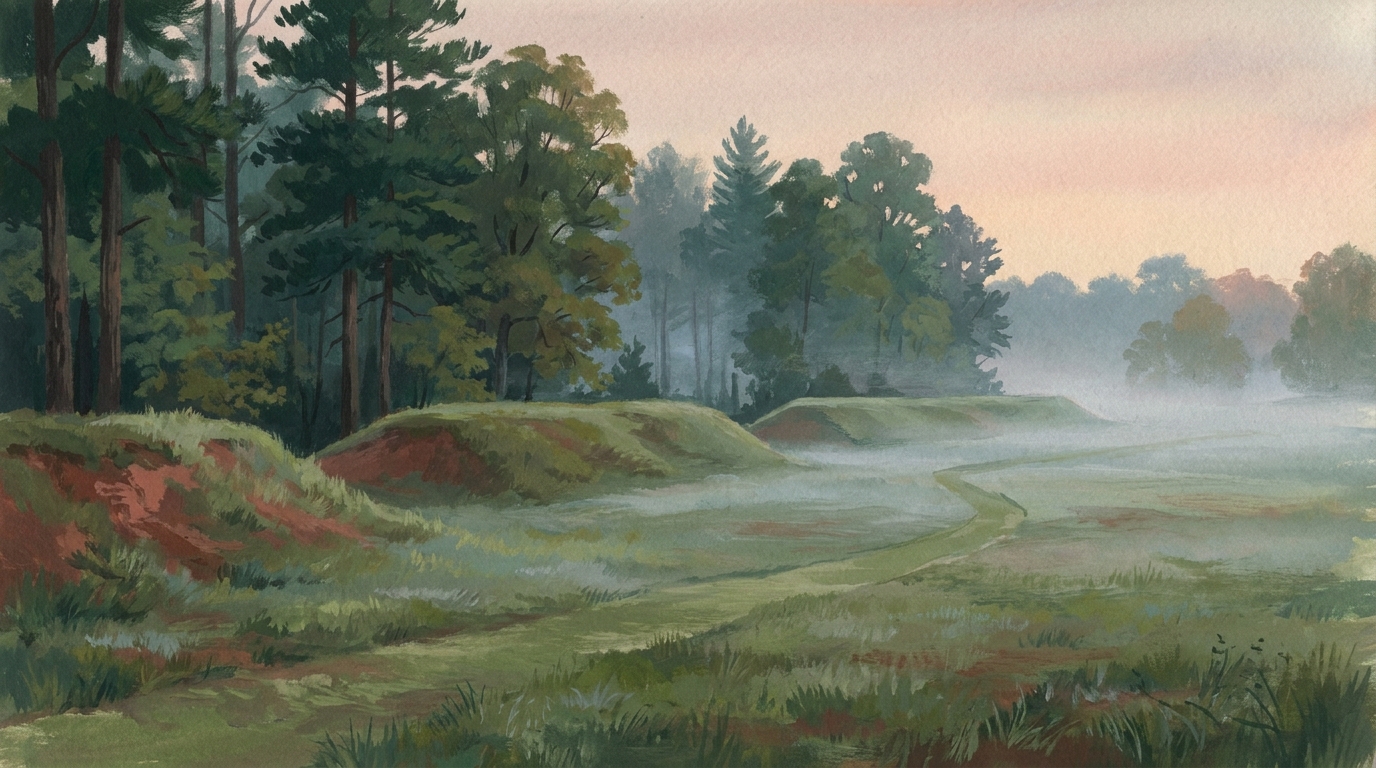
- A tour road and walking trails that follow preserved Confederate and Union earthworks through the woods.
- The Garthright House, which served as a Union field hospital during the battle.
- Cold Harbor National Cemetery, where Union soldiers are buried.
- Interpretive signs that explain the positions of the corps on June 1 and June 3.
Plan one to two hours for the trails. Hours at the visitor center change with the season, so check the park’s website before you go. Rural Plains at Totopotomoy Creek, Cold Harbor and the Gaines’ Mill site together make a full day of history in Hanover County.
Key facts
- Dates: May 31 to June 12, 1864
- Place: Old Cold Harbor crossroads, Hanover County, Virginia
- Campaign: Grant’s Overland Campaign
- Result: Confederate victory, Union withdrawal toward Petersburg
- Losses: about 12,000 Union and almost 4,000 Confederate
Questions and answers
Who won the Battle of Cold Harbor?
The Confederate Army of Northern Virginia under Robert E. Lee held its lines. Grant withdrew on the night of June 12 and moved south across the James River toward Petersburg.
Where is the Cold Harbor battlefield?
It lies just southeast of Mechanicsville in Hanover County, about ten miles northeast of Richmond, and is part of the Richmond National Battlefield Park.
Is there an entry fee for the Cold Harbor battlefield?
No. The trails and tour road are free. Visitor center hours change with the season.
Sources
- National Park Service: Cold Harbor
- National Park Service: Richmond National Battlefield Park
- Ulysses S. Grant: Personal Memoirs (1885)
Last reviewed: